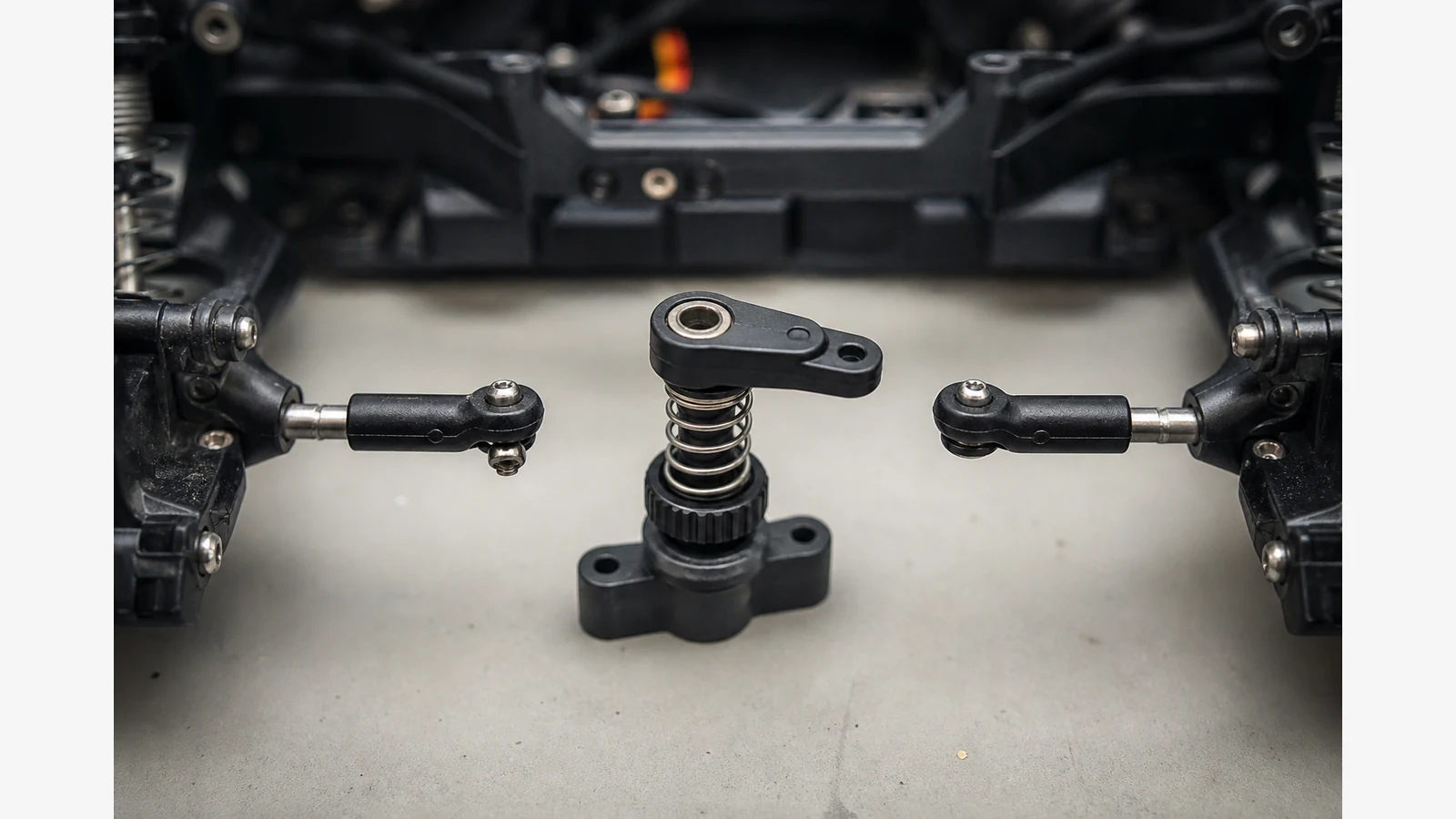
RC Servo Saver Too Loose or Too Tight? Read the Symptoms Before Adjusting
Loose steering play and over-tight impact transfer are different problems. Excess slop often points to a worn or under-preloaded saver, while a saver that will not yield can pass crash energy straight into the servo gears. Read the symptoms with power off before changing preload—and use only the vehicle manual’s adjustment or replacement method, not universal turn counts.
This UK comparison stays at general mechanical principles. It does not prescribe spring positions, invent force values or claim that changing the saver proves a servo upgrade is required.
Loose play versus over-tight transfer: what you feel
| Symptom cluster | More consistent with | What not to assume |
|---|---|---|
| Steering feels vague on centre, wheels flutter over bumps, horn moves before the rack responds | Loose or worn saver, missing hardware or related steering slop | That the radio needs more dual rate or that the servo lacks torque |
| Links feel solid with almost no give, full lock buzzes hard, impacts seem to shock the servo case | Over-tight preload or a saver that no longer yields as designed | That endpoints alone will protect the gears if the mechanism is already jammed |
| Play remains after the saver is held firm by hand | Worn rod ends, bearings, horn splines or rack play elsewhere | That tightening the saver will remove every source of slop |
Vehicle manuals commonly ask you to check the steering mechanism for looseness or binding, re-centre the servo if alignment cannot be achieved, keep left and right travel comparable, and replace a worn servo saver when steering becomes loose.
Power-off checks before any preload change
- Inspect for cracks, flattened hexes, missing clips, deformed springs and horn screws that have backed out.
- Separate saver movement from rod-end wear, bearing grit, spline wear and rack play by holding one joint at a time.
- Move the wheels by hand through the free range and note where resistance suddenly spikes near full lock.
- Confirm endpoints are not already pushing the servo against a mechanical stop; commanding more travel than the parts allow can permanently damage the servo.
Buzz or flutter from bind should be corrected promptly because a stalled path can draw excessive current. Check mounting screws and linkages as part of the same inspection.
Adjust or replace only the way the vehicle manual allows
Use the published adjustment or replacement method for your chassis. Avoid universal preload values copied from another model. After any saver service, recheck centre, linkage length and left/right endpoints so the servo is not driving into the stop.
If the saver is cracked, the spring no longer returns consistently, or play returns immediately after careful assembly, replacement is usually safer than stacking washers or inventing a tighter setting.
Stop conditions, next step and FAQ
Stop power for abnormal heat, smell, smoke, damaged wiring, grinding or a stalled output. Do not open electronics or bypass protection.
When steering geometry is healthy again and you are comparing a standard-size brushless steering servo for heavy 1/8 or upgraded 1/10 use, review the BrushServo BLS-HV70MG product page as a soft browse step—not as proof that a saver symptom requires that product. Only a 12-month warranty duration is stated here for that offer.
FAQ
Can a loose saver mimic a weak servo?
Yes. Centre vagueness and delayed rack response can feel like low authority even when the servo is healthy. Inspect the saver and related joints before changing electronics.
Is tighter always safer for big tyres?
No. An over-tight saver can transfer impact energy into the geartrain. Follow the vehicle manual rather than maximising preload.
Should I invent a spring turn count from a forum?
No. Preload and hardware differ by chassis. Use the manual method for your vehicle.
Does replacing the saver mean the servo survived the crash?
Not necessarily. After saver service, recheck for grinding, heat and centre hold. Damaged gears need service or replacement on their own merits.