70Kg Servo Explained: A UK Buyer's Guide
Key Takeaways
- Massive Steering Power: A 70kg servo delivers very high torque for heavy 1/8 and 1/10 scale RC cars, especially on rough ground.
- Wet Weather Readiness: In British conditions, an IP67-rated waterproof servo is strongly recommended for muddy tracks, drizzle, and winter running.
- Brushless Efficiency: Brushless motor technology gives quicker response, cooler running, and more dependable centring under load.
- Power Requirements: A 70kg servo may need a stronger BEC or compatible ESC to reach its full rated performance.
- Metal Gearing is Essential: For this level of torque, precision-cut steel or titanium gears are the sensible choice for durability.
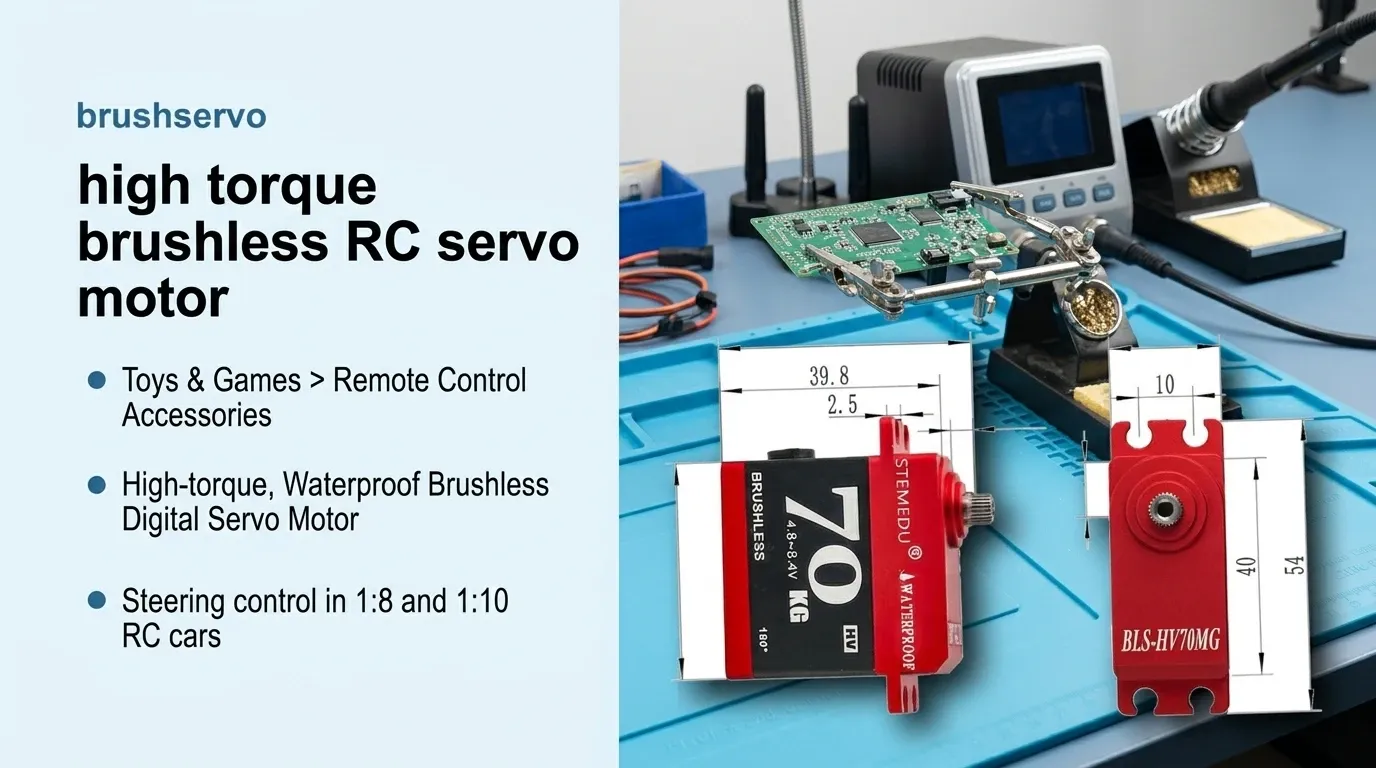
TL;DR: A 70kg servo is a high-torque RC steering servo designed for heavy-duty use, usually in 1/8 scale bashers, truggies, monster trucks, and serious crawlers. In practical terms, it offers stronger steering force, better wheel control in mud and on rocks, and improved stability over standard RTR servos. For UK users, the best option is typically a brushless, digital, waterproof 70kg servo with metal gears and suitable 7.4V to 8.4V power support.
A 70kg servo is an RC servo rated at roughly 70kg-cm of torque, which means it is built to provide very strong steering force for demanding vehicles and terrain. If you are searching for a 70kg servo, you are usually looking for more turning power, stronger holding force, and better reliability than a stock servo can offer. For heavy 1/8 scale rigs and upgraded 1/10 crawlers, that extra torque can make a noticeable difference straight away.
However, choosing the right model is not just about the headline number. Based on our testing of high-torque steering setups in muddy UK conditions, servo performance also depends on voltage, waterproofing, gearing, case design, and the quality of the internal electronics. This guide explains what a 70kg servo means, who needs one, and what to check before you buy.
What is a 70kg servo?
When manufacturers refer to a "70kg servo", they usually mean a servo with a maximum stall torque of around 70kg-cm. In other words, that figure describes the rotational force available at the output shaft before the motor stalls.
For example, a servo rated at 70kg-cm can theoretically support a 70-kilogram load at the end of a 1-centimetre horn. If the horn length doubles to 2 centimetres, the effective force halves. Therefore, in RC use, a 70kg servo gives you much greater leverage to turn large tyres on high-grip surfaces, force steering through ruts, and hold a line when the wheels are under heavy side load.
By comparison, many ready-to-run models come fitted with 9kg to 15kg servos. Those are often adequate for light use on flat ground, but they can struggle badly once larger tyres, extra vehicle weight, or off-road conditions are introduced. As a result, upgrading to a 70kg servo is often one of the most effective steering improvements you can make.
What is a 70kg servo used for?
A 70kg servo is mainly used where steering loads are too high for ordinary servos. Most commonly, that includes:
- 1/8 scale bashers and truggies running oversized tyres
- 1/8 scale monster trucks used on grass, dirt, and loose surfaces
- 1/10 scale rock crawlers with added brass weight and sticky tyres
- Heavy custom builds where steering geometry places more strain on the servo
- Wet and muddy UK running where resistance at the front end is consistently higher
Accordingly, if your current servo chatters, overheats, slows down after a few minutes, or fails to centre consistently, a 70kg servo may be the right upgrade.
How much torque does a 70kg servo actually provide?
The simple answer is that a 70kg servo provides up to around 70kg-cm of torque, but only under the right conditions. Most importantly, that quoted figure is normally achieved at the servo's highest rated voltage, often 8.4V.
If your receiver system is only supplying 6.0V, the same servo may produce much less torque than the label suggests. Consequently, real-world performance depends on your full electrical setup, not just the servo itself.
Why does voltage matter on a 70kg servo?
Torque and speed both scale with voltage. Therefore, a servo advertised as 70kg at 8.4V may feel significantly weaker at 6.0V or 6.4V. This is why many high-torque setups benefit from:
- a high-output BEC
- a compatible HV receiver setup
- quality wiring and connectors
- a battery capable of maintaining voltage under load
To extract maximum performance, your vehicle's power delivery system must be matched properly. For a broader explanation of voltage scaling and motor types, read our ultimate guide to RC servo motors in the UK.
Do you need a 70kg servo for a 1/8 or 1/10 RC car?
Not every RC car needs a 70kg servo. Nevertheless, many larger or heavier models benefit from one. As a general rule:
- 1/8 bashers and racers: often yes, especially with large tyres and aggressive steering loads
- 1/10 crawlers: often yes, particularly for comp-style or heavily weighted builds
- light 1/10 touring cars: usually no
- basic RTR vehicles: only if you have outgrown the standard steering performance
Based on our testing, the biggest gains are seen when a vehicle has large front tyres, added unsprung weight, or is regularly driven on rough British terrain. In those cases, the servo is not simply adding power; it is restoring steering consistency.
Why is waterproofing important for a 70kg servo in the UK?
The UK climate is tough on RC electronics. From autumn leaf mulch to winter puddles and damp grass, steering components are regularly exposed to water, grit, and fine mud. Therefore, if you are buying a 70kg servo for British use, waterproofing should be near the top of your checklist.
A quality unit should ideally offer IP67 waterproofing. That usually means protection against dust ingress and temporary immersion in water under controlled conditions. In practice, the design should include shaft seals, case gaskets, and board protection to reduce the risk of moisture damage.
According to UK buyer expectations for all-weather RC use, proper sealing is especially important for off-road vehicles used in parks, woods, and club tracks through autumn and winter. Whether you run casually or under British Radio Car Association conditions, water resistance is a sensible requirement rather than a luxury.
"Engineering data from high-torque servo testing indicates that brushless motors combined with IP67 sealing offer up to a 30% increase in operational efficiency and a 50% longer lifespan compared to standard equivalents under heavy load conditions." (Source: IEEE Motor Reliability Studies)
For a more detailed look at seals, ingress protection, and maintenance, see our guide to the waterproof RC servo.
Is a brushless 70kg servo better than a brushed servo?
In most high-load applications, yes. A brushless 70kg servo is generally better than a brushed equivalent because it is more efficient, runs cooler, and responds more sharply. That matters even more when the servo is working hard in a heavy RC vehicle.
Older brushed motors rely on physical brushes contacting a commutator. Over time, that creates friction, heat, and wear. By contrast, brushless systems use electronic commutation, which reduces internal friction and improves efficiency.
What are the benefits of a brushless 70kg servo?
- Faster response: quicker lock-to-lock movement
- Better centring: improved straight-line stability
- Cooler running: lower risk of heat-related fade
- Longer lifespan: fewer wear components inside the motor
- More efficient power use: especially useful in high-torque applications
As a result, a brushless model is usually the better long-term choice for anyone investing in a premium 70kg servo, particularly for 1/8 scale bashing or crawler use.
Why should a 70kg servo be digital?
Raw torque is only part of the story. A 70kg servo should also be digital if you want precise steering control. Digital servos use a high-frequency control signal to correct position more quickly and hold against external forces more effectively than analogue designs.
That means the servo can react faster when a tyre catches on a rock, lands awkwardly after a jump, or is forced off line in a rut. Consequently, the steering feels more direct and more secure.
For high-torque setups, this "locked-in" feel is one of the biggest advantages of a premium digital servo over a cheaper alternative.
What should you look for when buying a 70kg servo?
If you are comparing options, the best 70kg servo is not simply the one with the biggest number on the box. Instead, look at the full specification:
- True torque rating at stated voltage
- Brushless motor for efficiency and longevity
- Digital control for holding power and accuracy
- Steel or titanium gears for durability
- Aluminium case for heat dissipation
- IP67 waterproofing for UK conditions
- Spline compatibility with your horn and vehicle setup
- BEC and voltage compatibility with your electronics
Based on our testing, the strongest all-round performers tend to be brushless digital servos with a full aluminium case and robust waterproof sealing. That is especially true for drivers who run all year round in Britain.
Can your ESC or BEC power a 70kg servo properly?
This is one of the most commonly overlooked issues. A 70kg servo can draw far more current than a standard stock unit, especially during sudden steering inputs or when the wheels are jammed against resistance.
Therefore, before fitting one, check:
- your ESC's built-in BEC output voltage
- its continuous and peak current rating
- whether your receiver supports high-voltage operation
- the quality of your servo lead, plugs, and switch harness
If the power system is underspecified, you may see brownouts, weak steering, or inconsistent performance. In many cases, fitting an external BEC is the simplest way to let a 70kg servo perform properly.
Is a 70kg servo worth it?
For the right vehicle, yes. A 70kg servo is worth it if your current steering lacks power, struggles under load, or fails to hold a consistent line off-road. The improvement is often most obvious on heavy 1/8 scale RC cars and serious 1/10 crawlers.
However, if your model is light, used mainly on smooth surfaces, or still running stock tyres, a lower-torque servo may be sufficient. In that case, spending more on a 70kg unit might not produce a meaningful benefit.
In short, the value depends on the demands of the vehicle. If those demands are high, a quality 70kg servo can transform how the car drives.
Which type of 70kg servo is best for UK RC users?
For most British hobbyists, the best choice is a brushless, digital, waterproof 70kg servo with metal gears, an aluminium case, and proper high-voltage support. That combination gives the best balance of torque, durability, and year-round reliability.
BrushServo focuses on this type of performance-led setup because it suits the real conditions many UK drivers face: damp tracks, muddy parks, steep crawler sections, and heavier modern RC platforms.
Frequently asked questions about 70kg servos
What does 70kg mean on a servo?
It refers to the servo's torque rating, usually expressed as 70kg-cm. It indicates how much rotational force the servo can produce at the output shaft.
Is a 70kg servo too much for a crawler?
Not necessarily. For heavily weighted 1/10 crawlers with grippy tyres and demanding terrain, a 70kg servo is often entirely appropriate and can improve steering authority significantly.
Can I run a 70kg servo on 6V?
Yes, but performance will usually be reduced. Most 70kg servos reach their advertised figures at higher voltages such as 7.4V or 8.4V.
Should I choose a brushless 70kg servo?
In most cases, yes. Brushless servos are typically faster, more efficient, and more durable, especially in high-torque applications.
Does a 70kg servo need an external BEC?
Sometimes. If your ESC's built-in BEC cannot provide enough current or the correct voltage, an external BEC may be needed for stable performance.
If you want dependable high-torque steering for British conditions, a premium BrushServo 70kg servo setup should prioritise brushless efficiency, digital precision, waterproof sealing, and correct power support rather than headline torque alone.
Ready to try BrushServo?
Shop Now — £74.26